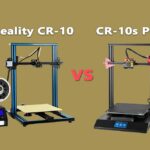
The Creality CR-10 S4 has one job in the CR-10 family: to be the big one that is not the biggest. And first, the number this page exists to correct — its build volume is 400 × 400 × 400 mm, not the “10 × 10 × 10 inches” the old version of this article claimed (that would be a printer barely bigger than a standard CR-10). The S4 sits in the middle of the S-series ladder: the CR-10S at 300 mm cubed below it, the CR-10 S5 at 500 mm cubed above it, all three sharing the same formula — dual Z screws, a filament runout sensor, a glass bed and a separate control box. This guide covers the S4’s real specifications and the ownership realities that come with a bed this size on this hardware.
Creality CR-10 S4 specifications
| Specification | Creality CR-10 S4 |
|---|---|
| Build volume | 400 × 400 × 400 mm |
| Series position | CR-10S (300³) → S4 (400³) → CR-10 S5 (500³) |
| Frame | Aluminium extrusion gantry, separate control box |
| Z drive | Dual leadscrews, dual motors |
| Extruder | Single Bowden extruder, 0.4 mm nozzle |
| Bed | Heated glass bed, 400 × 400 mm, manual levelling |
| Filament sensor | Yes — runout detection |
| Mainboard | Creality V2.x 8-bit (ATmega2560), 12 V system |
| Display | 12864 LCD on the control box |
What 400 mm cubed actually buys you
Volume is the S4’s argument, and it is a strong one. At 400 mm in every direction it swallows the projects that define the big-Creality niche: full-size helmets and cosplay armour sections in one piece, large enclosures and jigs, architectural models, and production-style batches of smaller parts nested across that wide bed. Compared with the standard CR-10S it offers roughly two and a third times the printable volume — the difference between “print it in pieces and glue” and “print it whole”. Against the S5 above it, the S4 is the slightly more manageable machine: a smaller footprint, a bed that is marginally less of a commitment to heat and level, and (usually) a lower used price, in exchange for giving up the 500 mm bragging rights few owners genuinely use in Z.
The honest costs of a big bed on 12 V hardware
- Heat-up time. A 400 × 400 mm bed on the CR-10S family’s 12 V system takes its time getting to temperature, and high bed temperatures for ABS-class materials are a patience test. This is the S4’s best-known trait, and it is physics, not a fault — the heating guidance in our companion piece on the CR-10 S4 heated bed goes into it directly.
- Levelling is a bigger job. Four knobs and a large glass plate mean more distance for error to hide in. Get it right and big first layers are glorious; get it wrong and you discover it forty minutes in. The method is the same ladder as the standard CR-10 — level, temperature, surface — scaled up; our CR-10 bed adhesion guide covers it.
- Mass moves slowly. A heavy bed and a tall gantry reward moderate speeds and accelerations. The S4 is a machine for large, patient prints, not a speed printer — trying to run it like one shows up as ringing and layer shift.
- Dual Z needs occasional squaring. Two screws and two motors can drift a step apart over time, tilting the gantry almost invisibly. A periodic check and re-sync is part of S-series ownership, exactly as on the CR-10S.
Ownership today
The S4 is discontinued and lives in the same healthy ecosystem as the rest of the CR-10S family: V2.x boards (the V2.1 mainboard guide covers identification and replacement), standard nozzles, belts, wheels and PTFE are all generic and available. What to inspect on a used S4 matters more than the badge: check the big glass bed for chips and warp, run the bed heater and watch it actually climb, confirm both Z motors turn together, and budget bench space honestly — with its control box, this is not a small machine. Bought for its size, in good order, it remains one of the cheapest routes into genuinely large-format FDM printing.
Frequently asked questions
What is the CR-10 S4’s build volume?
400 × 400 × 400 mm. The “10 × 10 × 10 inches” figure in older articles is wrong — that describes a printer closer to the standard CR-10 class. The S4 is the middle of the S ladder: CR-10S 300³, S4 400³, S5 500³.
What is the difference between the CR-10S, S4 and S5?
Size, essentially. All three share the S formula — dual Z, filament sensor, glass bed, separate control box, V2.x 8-bit electronics. The CR-10S prints 300 mm cubed, the S4 400 mm, and the S5 500 mm, with heat-up time, footprint and price climbing alongside.
Does the CR-10 S4 have a heated bed?
Yes — a heated glass bed across the full 400 × 400 mm. On its 12 V system it is slow to reach high temperatures, which is the machine’s best-known compromise and the reason planning heat-up time into big prints is normal S4 ownership.
Does the CR-10 S4 have dual Z and a filament sensor?
Yes to both — they are what the “S” in the name stands for in this family: twin leadscrews with twin motors, and a runout sensor that pauses the print when the spool empties.
Is the CR-10 S4 worth buying used?
If you need the volume, yes — it is one of the most affordable ways into 400 mm-class printing. Inspect the bed, heaters and both Z motors, expect slow heat-ups and patient print speeds, and it will do the job it was designed for.
Hassan Khan

Hassan Khan is a leading voice when it comes to the innovative world of additive manufacturing. A mechanical engineer by training, Hassan quickly recognized the transformative potential of 3D printing, diving headfirst into the intricacies of printer design, filament research, and software optimization. At CrealityLovers.com, Hassan shares his profound knowledge, from insightful reviews and tutorials to forward-thinking op-eds that forecast the future of 3D printing. Hassan's commitment goes beyond the written word. Hassan Khan aims to empower every reader, from novices to industry experts, ensuring they make informed decisions in their 3D printing endeavors.