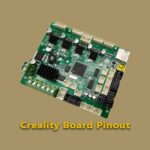
If you open the control box of a Creality CR-10S, the mainboard inside will be one of three close relatives: the V2.0, the V2.1, or the V2.2. They are production revisions of the same 8-bit board — same layout, same job — and the V2.1 is the middle child: the board a large share of CR-10S machines (and their S4/S5 siblings) actually shipped with. This guide covers what the V2.1 is, how it differs from the versions either side of it, and what your options are when one fails or starts to feel its age.
Creality V2.1 mainboard at a glance
| Specification | Creality V2.1 (CR-10S family) |
|---|---|
| Processor | ATmega2560 — 8-bit, 16 MHz (Marlin firmware) |
| Input voltage | 12 V (as fitted in the CR-10S) |
| Stepper drivers | Integrated A4988-class drivers (X, Y, Z, E) |
| Motor outputs | X, Y, dual Z, single extruder — the twin Z sockets are a CR-10S signature |
| Heater outputs | Hotend + heated bed (MOSFET-driven) |
| Sensor inputs | X/Y/Z endstops, hotend and bed thermistors, filament runout sensor |
| Display | 12864 graphic LCD on dual ribbon cables (EXP1/EXP2) |
| Connections | USB (printing and flashing), SD card slot on the display |
| Found in | CR-10S, CR-10 S4, CR-10 S5 and related CR-S machines of the period |
Read the table and you know the era: an Arduino-Mega-class brain, real dual-Z drive for the CR-10S’s two leadscrews, a filament sensor input (a headline CR-10S feature), and everything soldered down as one unit. Nothing on this board is socketed or modular — which is exactly why its replacement logic (below) is “revision or upgrade”, never “repair the one chip”.
V2.0, V2.1 or V2.2 — what actually changed?
Less than the version numbers suggest, and it is worth saying so plainly, because old forum posts sometimes treat them as different boards. All three are the same ATmega2560 platform with the same connectors in the same places; a V2.x board is a drop-in replacement for another V2.x board in the same machine, wiring for wiring. The revisions were running production changes — component sourcing and small refinements — not redesigns.
The one difference owners can hear arrived with the V2.2: it moved to silent TMC2208 stepper drivers, which is why a late CR-10S is dramatically quieter than an early one. The V2.1 sits on the earlier side of that line — A4988-class drivers, with the characteristic stepper whine of its generation. Our V2.2 mainboard guide covers that version in the same detail.
Which one do you have? The version is printed on the board itself — “Creality3D” and the version number in the silkscreen, visible once the control box is open (power off, and photograph the wiring before unplugging anything; our board pinout guide shows the connector layout these boards share). Check before ordering parts or flashing firmware builds — most CR-10S firmware is shared across V2.x, but driver-related settings are not.
Firmware on the V2.1
The V2.1 runs Marlin on the ATmega2560, and it has a bootloader, so firmware is flashed over USB with the Arduino-era tooling (or any modern Marlin build compiled for the CR-10S/mega2560 target). Three practical notes:
- Your settings live on the board. E-steps, offsets and any tuned values are stored in the board’s EEPROM. A board swap or a full firmware flash can reset them — write them down first, and re-check them after (the values themselves are covered in our calibration guide).
- Match the build to the machine, not just the board. CR-10S firmware assumes dual Z, the filament sensor and the 12864 dual-ribbon display. A generic “Creality” build that assumes a different display or single Z will misbehave in ways that look like hardware faults.
- 8-bit limits are real but modest. The ATmega2560 handles the CR-10S’s job perfectly well; where it shows its age is in fancy extras (heavy input shaping, large colour touchscreens, fast host features), not in ordinary printing.
When a V2.1 fails: replace, or upgrade?
Board deaths on this platform usually announce themselves clearly — a dead axis channel, a heater output stuck on or off, USB no longer enumerating, or a board that will not boot at all. Once wiring and the power supply are ruled out (always rule those out first — they imitate board failure faithfully), the choice is:
- Like-for-like (V2.2): the same board with silent drivers. Identical wiring, identical firmware family, quieter machine at the end. This is the lowest-risk path and the one most owners should take.
- A modern 32-bit board: the bigger jump — more firmware headroom, better driver options, modern displays. But it is a project, not a swap: check the board suits a 12 V machine, expect the dual-ribbon display to need attention (many compact 32-bit boards have a single display port), and budget an evening for firmware configuration. Worth it for tinkerers; overkill for getting a working printer back.
- What not to do: do not fit a 24 V-era Ender board (such as the 4.2.x series) into a 12 V CR-10S on the assumption that “Creality boards are all alike”. They are not — voltage, connectors and display all differ.
Frequently asked questions
Is the Creality V2.1 a silent board?
No. The V2.1 uses A4988-class drivers and makes the stepper noise normal for its generation. The silent version of this board family is the V2.2, which moved to TMC2208 drivers — the practical upgrade if noise is your complaint.
How do I know if my CR-10S has the V2.1 board?
Open the control box (power off) and read the version printed on the board’s silkscreen. The three V2.x revisions share a layout, so the printed version — not the connector arrangement — is the reliable identifier.
Can the V2.1 run modern Marlin?
Yes — Marlin 2.x builds for the CR-10S target (ATmega2560) run on it, flashed over USB. Use a configuration that matches the CR-10S: dual Z, filament runout sensor and the 12864 dual-ribbon display.
Is a V2.2 a direct replacement for a V2.1?
Yes. Same form factor, same connectors, same machine wiring — the swap is wiring-for-wiring, and you gain silent drivers. Re-enter your stored settings (E-steps and offsets) afterwards, and confirm the firmware build matches a TMC-driver board.
My CR-10S stopped mid-print — is it the board?
Not necessarily, and not first. Power supply problems, a failing SD card, loose heater or thermistor wiring and a tripped thermal protection all imitate board failure. Rule out power and wiring before condemning the V2.1 — it is a durable board, and the fault is elsewhere more often than not.
Hassan Khan

Hassan Khan is a leading voice when it comes to the innovative world of additive manufacturing. A mechanical engineer by training, Hassan quickly recognized the transformative potential of 3D printing, diving headfirst into the intricacies of printer design, filament research, and software optimization. At CrealityLovers.com, Hassan shares his profound knowledge, from insightful reviews and tutorials to forward-thinking op-eds that forecast the future of 3D printing. Hassan's commitment goes beyond the written word. Hassan Khan aims to empower every reader, from novices to industry experts, ensuring they make informed decisions in their 3D printing endeavors.