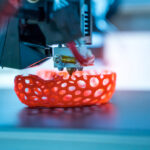
The Creality CR-7 is the smallest machine ever to wear the CR name — a mini desktop printer from Creality’s early years, designed to sit in a corner of a desk and print small things. That makes the correction this page owes you a big one, proportionally: the old version of this article listed its build volume as 220 × 220 × 250 mm — Ender 3 dimensions, and nearly four times the CR-7’s real size. The CR-7 actually prints about 130 × 150 × 100 mm. Everything else about the machine follows from that number: it is a small, simple, portable PLA printer, and judged as that — not as a shrunken Ender — it makes sense.
Creality CR-7 specifications
| Specification | Creality CR-7 |
|---|---|
| Build volume | About 130 × 150 × 100 mm |
| Class | Mini / portable desktop FDM printer |
| Extruder | Single extruder, 0.4 mm nozzle |
| Heated bed | No — PLA-class printing |
| Levelling | Manual |
| Filament | 1.75 mm — PLA is the intended material |
| Role | Small parts, models, learning and demonstration printing |
What a printer this small is actually for
A 130 × 150 × 100 mm envelope rules out helmets, brackets of any size and most functional parts — and includes a surprising amount of everyday printing: miniatures and game pieces, small toys, keyrings and badges, knobs, clips, cable tidies, test pieces and calibration objects, and the endless stream of little household fixes that are smaller than your palm. Mini printers of this era were bought as first printers, classroom and demonstration machines, gifts for kids starting out, and travel/portable printers (the CR-7’s small frame and light weight were the point of the design). Judged against that brief, its simplicity is a feature: no heated bed to wait for, a tiny footprint, and very little to adjust.
The constraints are equally real. No heated bed means PLA is the material — PETG and ABS need bed heat for reliable adhesion and warp control, and a machine of this class was never meant for them. Manual levelling on a small bed is at least quick. And small Z height (100 mm) is the limit that bites most often in practice, ending project ideas that the X and Y dimensions would otherwise allow.
The CR-7 in the Creality family
The CR-7 is a reminder that “CR” once spanned a huge range: the same branding covers this 130 mm mini and the 500 mm CR-10 S5. Nothing about the CR-7 carries over to the bigger machines except the name and the era — different scale, different parts, different purpose. Creality’s line moved on to the Ender family for small printers, and today’s equivalent buying decision is a compact modern machine from the current range in our Creality buying guide — which will be bigger, heated-bed equipped and better supported than any mini of the CR-7’s generation. The little machine’s remaining value is charm, portability and price on the used market: as a second printer for small PLA jobs, or a low-stakes way to learn the basics, it can still earn its (very small) footprint.
Frequently asked questions
What is the Creality CR-7’s build volume?
About 130 × 150 × 100 mm — it is a mini printer. The 220 × 220 × 250 mm figure in older articles belongs to the Ender 3 class and is roughly four times the CR-7’s true volume.
Does the CR-7 have a heated bed?
No. The CR-7 was designed as a simple, portable PLA printer, and the absence of a heated bed is why PLA is its material — filaments needing bed heat for adhesion and warp control are outside its intended use.
What can you print on a CR-7?
Anything that fits in roughly 130 × 150 × 100 mm and prints in PLA: miniatures, small toys, keyrings, clips, knobs, test and calibration pieces, and small household items. If a model doesn’t fit, it was never a CR-7 project.
Is the CR-7 related to the CR-10?
Only by branding and era. The CR line of those years ran from this mini up to the 500 mm CR-10 S5; the machines share almost no parts or design beyond the name. Think of the CR-7 as Creality’s early mini experiment, not a small CR-10.
Is a CR-7 worth buying today?
As a curiosity, a portable PLA-only second printer, or a very cheap learning machine — possibly, at the right used price and in working order. As your only printer, a modern compact machine with a heated bed is the better buy in every practical respect.
Hassan Khan

Hassan Khan is a leading voice when it comes to the innovative world of additive manufacturing. A mechanical engineer by training, Hassan quickly recognized the transformative potential of 3D printing, diving headfirst into the intricacies of printer design, filament research, and software optimization. At CrealityLovers.com, Hassan shares his profound knowledge, from insightful reviews and tutorials to forward-thinking op-eds that forecast the future of 3D printing. Hassan's commitment goes beyond the written word. Hassan Khan aims to empower every reader, from novices to industry experts, ensuring they make informed decisions in their 3D printing endeavors.